AI video for luxury and cosmetics.
Ryze AI Studios produces AI videos for fragrance, cosmetics, watchmaking, jewellery and fashion: launch spots, animated packshots, brand films and a recurring brand face. The product is always built from your files, never reinvented by AI. In cosmetics, an image counts as a claim: an effect shown on screen must be true and provable, just like a line of copy.
Why is video so demanding in luxury?
In luxury, you sell a feeling before a product: a material, a light, a gesture. Viewers judge in an instant whether the image matches the brand. Three requirements follow.
- The exact product. A bottle, a dial, a stone or a seam leaves no room for approximation.
- A consistent world. The same light, the same materials and the same tone from one campaign to the next.
- Many variations. The launch, stories, advertising, the product page, several markets and several languages.
AI helps most with the third point: adapting a world to every format without organising a new shoot each time. It does not replace art direction. Art direction decides what must never change.
Which video formats work for a fragrance, a skincare product or a watch?
| Format | What it is for | Proposed length and framing |
|---|---|---|
| Launch spot | Launch of a fragrance, a collection, a model | 6, 15 and 30 s versions, in 16:9, 9:16, 1:1 or 21:9 |
| Animated packshot | Product page, stories, Meta and TikTok ads | Short looping shots, in 9:16 and 1:1 |
| Brand film | Website, event, in-store screen | Length set in the quote, in 16:9 or 21:9 |
| Ambassador | Regular presence on Instagram and TikTok | To-camera and lifestyle videos in 9:16 |
| Brand series | Building loyalty around a world | Vertical episodes of 60 to 90 s |
These formats match the studio’s offers. The exact length of each deliverable is set in the quote.
What video ideas suit a luxury or beauty brand?
- Fragrance. Make the invisible visible: the top note as smoke, citrus or wood. Or a heroine reduced to a hand, never a face, as in the sample fragrance brief shown on the home page. A vertical mini-series can follow the same trail over several nights.
- Skincare and make-up. Texture in macro, a drop on glass, the application gesture in close-up. Without showing an effect on the skin that the product does not have (see below).
- Watchmaking. The movement in exploded view, the hand sweeping across a landscape, the same watch at three times of day.
- Jewellery. Light passing through the stone, the piece turning slowly on black, the jewel worn in a setting no shoot could bring together.
- Fashion. A runway in an imaginary place, the same piece worn in three eras, an animated lookbook adapted for each network.
For a long-term presence, anAI ambassador gives the brand a consistent face. For a launch, the brand film remains the core format.
What has the studio already produced in this field?
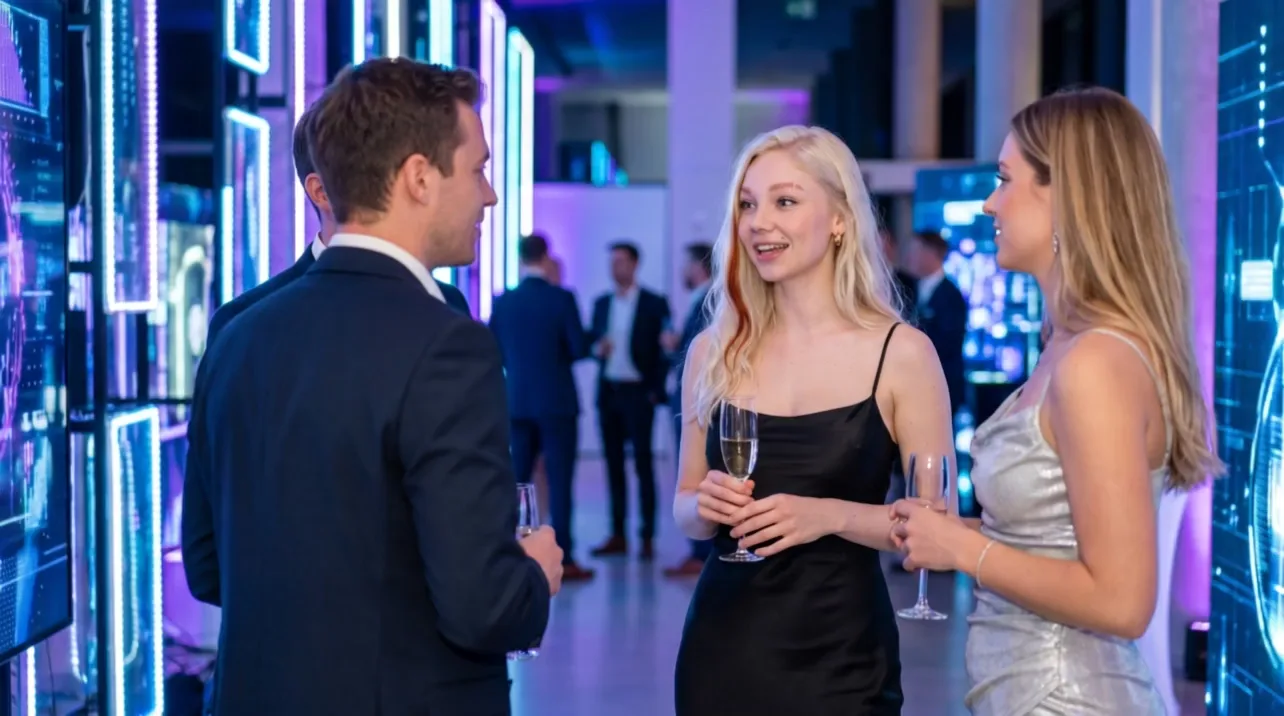
The showreel contains four-second vertical product spots, including a fragrance (Nebula) and a serum (Lumen). These are fictional brands created by the studio for the demo: no client is shown. It also features Katia Ryze, the studio’s AI-generated character, in a gala shot, in a black dress and in a neon night, as well as 21:9 shots from the private film “Sept Vies”.
What does the law say about cosmetic claims in video?
In Switzerland, the FDHA Cosmetics Ordinance (OCos, art. 10) prohibits using claims “in the form of texts, names, trademarks, images or other figurative signs” to attribute to a product characteristics or functions it does not have. Images are therefore covered, not just slogans.
In the European Union, Regulation (EU) No 655/2013 also applies to claims in the form of texts, names, trademarks and pictures. It sets six common criteria: legal compliance, truthfulness, evidential support, honesty, fairness and informed decision-making.
For an AI video, this translates very concretely:
- a generated before-and-after is not evidence: we do not show a result your tests do not support;
- perfect AI-generated skin can suggest an effect of the product, so we avoid it or frame it;
- the texture, shade and packaging shown are those of the product sold.
Watchmaking. In Switzerland, using “Suisse” or “Swiss made” on a watch is governed by a federal ordinance (SR 232.119). Its article 3 also covers signs, advertisements and brochures. A video must therefore not display “Swiss made” on a model that is not entitled to it.
General information, not legal advice. For a cosmetics campaign, have the claims approved by the person responsible for the product information file.
How does the studio keep the product exact on screen?
- Your files. Packshots, high-resolution photos, brand guidelines, references. The product, the logo or a real face are only built from your files, with your written consent and, for a face, the consent of the person.
- The script and the storyboard. You approve them before anything is rendered.
- Human selection. Shots where the product drifts (engraving, proportions, colour) are discarded.
- The variations. Formats, lengths and A/B versions for your campaigns, with voice-overs and subtitles in French, English and German if needed.
What does the studio not do for a luxury brand?
- Copy another house’s style or reproduce an existing campaign.
- Use the face of a celebrity or ambassador without their consent.
- Invent a product effect, a certification or an origin.
- Produce fake testimonials or fake customer reviews.
- Publish a price: every project is quoted on request.
Frequently asked questions
Can a fragrance ad be made entirely with AI?
Yes for the world around it: sets, light, smoke, camera moves. The bottle is built from your files, with your written consent. You approve the script and the storyboard before anything is rendered.
Can AI show the effect of a skincare product on the skin?
It can produce the image, but the law treats it as a claim. In Switzerland, the Cosmetics Ordinance (OCos) prohibits attributing to a cosmetic, including through images, functions it does not have. The studio only shows effects you can prove.
Do you have to say a luxury ad is AI-generated?
YouTube and TikTok ask creators to label realistic AI-generated content, and the EU AI Act requires a disclosure for deep fakes. The studio adds the label when regulation requires it and advises on the wording. The details are in the rights and disclosures guide.
Can a cosmetics brand have its own AI brand face?
Yes. The studio creates the character, its identity bible, voice and outfits, then produces to-camera and lifestyle videos. Usage rights are set in the quote. Katia Ryze, the studio’s own character, is the example.
How much does an AI luxury commercial cost?
Every project is quoted individually: the site publishes no price list. The amount depends on the number of versions, lengths, formats, languages and rights requested. The pricing page details these factors.
Read next
Sources
- Showreel, case studies, sample briefs, offers and method of Ryze AI Studios, accessed on 30 October 2026.
- FDHA Cosmetics Ordinance (OCos, SR 817.023.31), art. 10, version in force on 1 January 2026: juriup.ch.
- Commission Regulation (EU) No 655/2013 laying down common criteria for the justification of claims used in relation to cosmetic products, art. 1 and annex: eur-lex.europa.eu.
- Ordinance of 23 December 1971 on the use of the name “Switzerland” for watches (SR 232.119), art. 1a and 3, as of 1 January 2019: fhs.swiss.
- Regulation (EU) 2024/1689 on artificial intelligence, art. 50 (transparency obligations): ai-act-service-desk.ec.europa.eu.
- YouTube, “Disclosing use of altered or synthetic content”: support.google.com.
- TikTok, help page on AI-generated content: support.tiktok.com.
Last updated: 30 October 2026