AI video for tourism and hospitality.
Ryze AI Studios produces destination films, location reels, seasonal versions and historical reconstructions for tourism, with no crew on site. AI makes it possible to stage a place or a vanished era. But a hotel or destination must not look better than it is: travellers compare on arrival, and a realistic view of an existing place is labelled as generated.
What are the video challenges for a hotel or a destination?
- Seasons. You sell winter during summer, and the other way round. Filming snow in July is impossible with a camera.
- Weather and access. A summit at dawn, a terrace at sunset, a lake without mist: a shoot depends on the sky.
- Languages. Guests often speak French, English and German, sometimes on the same website.
- The promise. The film drives bookings, but the stay has to deliver what the image promises.
AI video removes the first three constraints. The fourth depends on you and the studio: we show your property as it is, in its best light, not another one.
Which video formats for a hotel, a tourist office or a museum?
| Format | What it is for | Proposed length and framing |
|---|---|---|
| Destination film | Home page, advertising, trade fair | 15 to 60 s, in 16:9 and 9:16 |
| Location reels | Instagram, TikTok, Shorts, every month | Short shots in 9:16 |
| Seasonal versions | The same place in winter and in summer | Same framing, two lights |
| Historical reconstruction | Museum, castle, old town, exhibition | Length set in the quote, often 16:9 or 21:9 |
| Guide character | A recurring voice and face for the destination | To-camera videos in 9:16 |
Versions in French, English and German (voice-over and subtitles) are an option on all offers.
What film ideas suit a destination or a hotel?
- Mountain hotel. The sample brief shown on the home page: the summit at dawn, the spa, the terrace. A winter version and a summer version. A tone made of silence, golden light and slow drone moves.
- Lakeside hotel. The same view from the room at four times of day, to sell the moment rather than the room.
- Tourist office. A single viewpoint filmed across the four seasons. Or a hiker’s path, from the village to the summit, in one continuous shot.
- Museums and heritage. The castle lived in as it once was, a lively medieval street, a period ship on the open sea.
- Events. A teaser that shows the atmosphere before the first edition, labelled as a staged scene.
What has the studio already produced for travel?
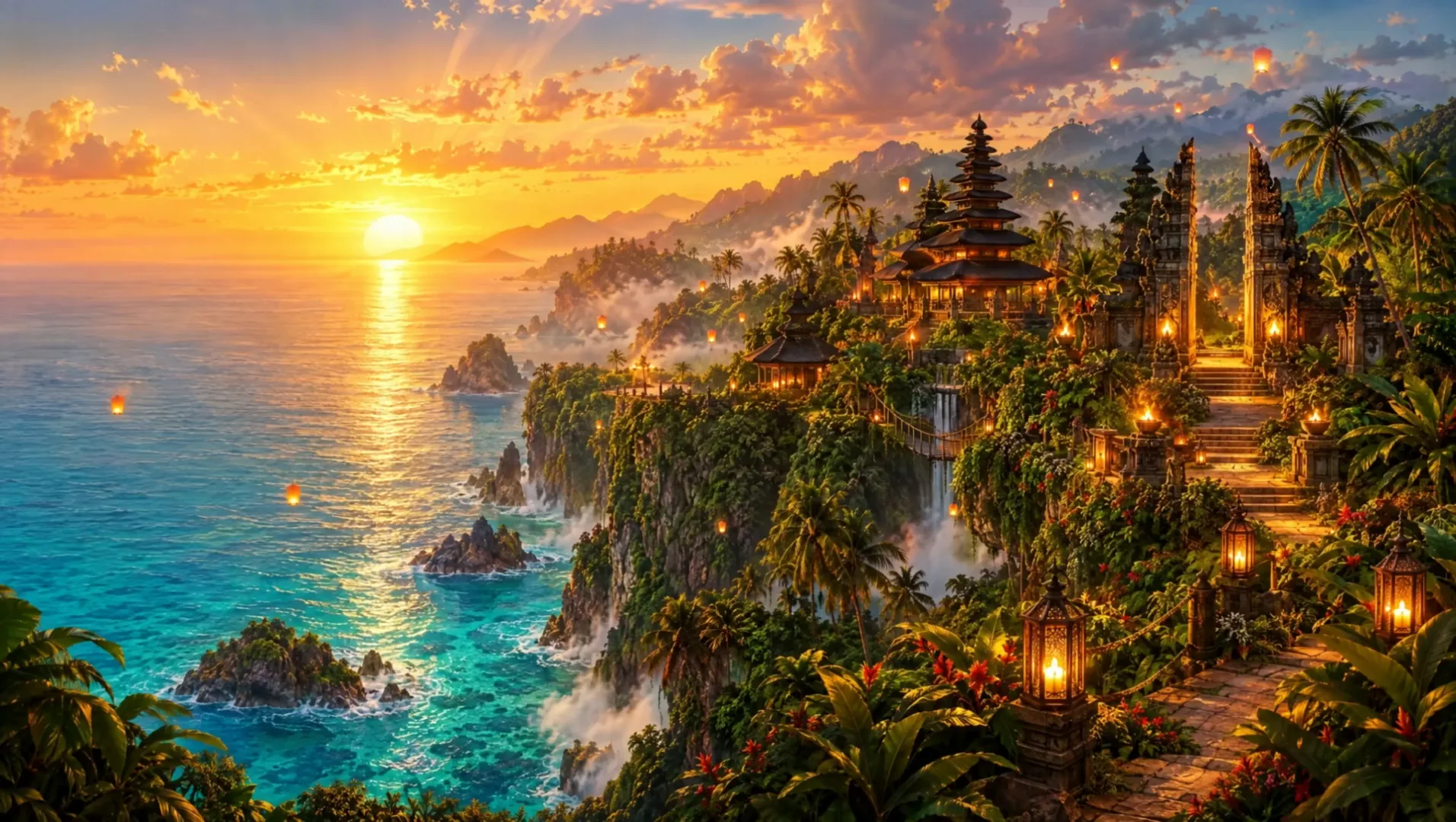
The showreel shows an aerial arc at sunset towards a temple in Bali, a drone orbit around the summit of Everest and a megacity in the rain: these are the worlds of Ryze Worlds, the gamified community of the Ryze ecosystem. The private film “Sept Vies” also shows reconstructions of past eras: a caravel on the open sea in 1492, riders in Kyoto in 1180. None of these videos was made for a client hotel or tourist office.
Can you show a real place with AI without misleading people?
Yes, on two conditions: promise nothing false, and say so.
Promise nothing false. In Switzerland, giving inaccurate or misleading information about one’s services is unfair (UCA, art. 3 para. 1 let. b). A lake view from a room that has none, an enlarged pool or a village without its recent buildings are a problem. The studio starts from your photos for everything guests will see on site.
Say so. The EU AI Act defines a deep fake as AI-generated or manipulated content that resembles existing persons, objects, places, entities or events and could falsely appear authentic. Places and events are therefore named expressly. Whoever publishes a deep fake must disclose that the content has been generated or manipulated (art. 50). For an evidently artistic or fictional work, the obligation is limited to disclosing that such content exists, in a way that does not hamper its display.
General information, not legal advice. The EU regulation also applies to players outside the Union when the content is used there: if you target European travellers, have your case checked.
How do you get an AI historical reconstruction right?
- The sources. Plans, engravings, texts and the advice of your curators or historians. AI knows nothing about your castle; it visualises what it is told.
- The script, approved by your experts. Costumes, architecture, objects: choices are approved on the storyboard before anything is rendered.
- The on-screen label. “Reconstruction” or “AI-generated images”. Viewers must not believe they are watching archive footage.
- The variations. A long version for the exhibition, a short version for social media, versions in three languages.
What does the studio not do for tourism?
- Show a facility, a view or a room that does not exist in your property.
- Pass a reconstruction off as archive footage.
- Use the faces of guests or staff without their consent.
- Promise bookings or a number of views.
Frequently asked questions
Can a hotel video be produced without a shoot?
Yes, starting from your photos of the rooms, spaces and views. AI animates and stages these real places. Everything guests will see on site must stay faithful: in Switzerland, a misleading statement about one’s services is unfair competition.
Is an AI historical reconstruction reliable?
It is as reliable as the sources it is given. The studio works from your documents and has your experts approve the script and storyboard before anything is rendered. The video carries a “reconstruction” or “AI-generated images” label.
Should you disclose that a destination film is AI-generated?
Yes, as soon as it shows a real place realistically. The EU AI Act expressly names places and events in its definition of a deep fake and requires this kind of content to be disclosed. The studio advises on the wording for each medium.
Can the studio deliver in German and English?
Yes. Voice-overs and subtitles in French, English and German are an option on every offer. List the languages you need in your request so they are included in the quote.
How much does an AI destination film cost?
Every project is quoted individually: the site publishes no price list. The amount depends on the length, the number of seasonal versions, the formats and the languages. The pricing page details these factors.
Read next
Sources
- Showreel, case studies, sample briefs, offers and method of Ryze AI Studios, accessed on 30 October 2026.
- Swiss Federal Act against Unfair Competition (UCA, SR 241), art. 3 para. 1 let. b: fedlex.admin.ch.
- Regulation (EU) 2024/1689 on artificial intelligence, art. 3, point 60 (definition of a deep fake): ai-act-service-desk.ec.europa.eu.
- Regulation (EU) 2024/1689 on artificial intelligence, art. 50 (transparency obligations): ai-act-service-desk.ec.europa.eu.
Last updated: 30 October 2026